The sports chair file
Every quad chair that comes out of a sideline trunk ships with a mesh loop sewn into the armrest — and reviewers of camp chairs describe the same three failures over and over: shallow, tippy, unable to hold a modern tumbler. That's not one bad batch of chairs; the loop, the ground under it, and nearly everything else at a sideline camp were built to do something other than hold a drink steady. Here's the physics behind each failure, what people already try, and what actually closes the gap.
The standard sideline quad chair — the folding, bag-carried chair that comes out of every trunk on a Saturday — sits about a foot and a half off the ground; Coleman's own Cooler Quad lists an 18.1-inch seat height. Into one armrest of that frame, manufacturers sew a mesh loop: a shallow fabric ring, not a rigid cup, sized for whatever a cooler-era sideline drink used to be.
That loop isn't a separate part bolted onto the chair. It's fabric stitched into the same tubing that flexes whenever someone leans on the arm to push up out of the seat. So the loop doesn't just fail to grip a wider tumbler — it's structurally tied to the one part of the chair that's guaranteed to move each time someone stands. Camp-chair reviewers describe the same three complaints across brand after brand: shallow, tippy, and unable to secure a wider bottle. That's not a manufacturing defect. It's a fabric ring, sewn to a moving frame, doing exactly what a fabric ring sewn to a moving frame was always going to do.
Spectators don't get flat ground because flat ground isn't the design goal of a playing field. Field-building guidance from the National Federation of State High School Associations calls for at least a 1.5% slope on surface-drained fields, and turf-management guidance recommends crowning fields at roughly 1 to 1.5% so rain sheds toward the sidelines instead of pooling at midfield. The exact strip of grass where the chairs go is the strip the water is engineered to run across.
Add cleats. A morning's worth of games chews the touchline turf into tufts and divots well before the graded slope even enters the picture, and an 8 a.m. tournament slot means all of it is still wet with dew. A drink set at the foot of a chair isn't standing on a hard, flat surface at all — it's balanced on a handful of grass blades, over soil that's already tilted on purpose.
Two more surfaces get pressed into service, and neither one is built to hold anything still. The sling seat is suspended polyester stretched across a frame — it bows into a bowl under any weight, including the weight of a cup someone sets down for a second while they stand to cheer. The fabric doesn't just fail to support the cup; it actively leans it toward the center as the material gives.
The cooler lid is the only genuinely flat surface most sideline camps have, which is exactly why nothing can stay on it for long — it has to open every few minutes for the halftime rush, and whatever's balanced there gets picked up, knocked, or handed to a kid the second the lid needs to swing. The wagon that hauls the whole camp between fields has the same problem in motion: its fabric bed bows in the center and rides every bump between one field and the next.
Where a field has bleachers, the seating itself becomes the obstacle. The planks are aluminum, slightly sloped, and gapped between the seat and the footboard below — and unlike grass, which at least holds still, an occupied row of aluminum rings and flexes with every stomp, cheer, and person standing to leave. A can or bottle set on a plank isn't just balanced on a narrow strip of metal; it's balanced on a narrow strip of metal that's actively moving underneath it.
When something on a bleacher does go over, it usually doesn't just fall — it rolls into the gap beside the footboard and drops straight through to the row below, out of reach until someone climbs down after it. That this happens often enough to matter isn't speculation: retrofit bleacher cup holders are an established product category in their own right, which only exists because bare bleacher planks lose drinks regularly enough to be worth solving.
None of this is new, and most of the obvious fixes solve an adjacent problem instead. Clip-on holders clamp to the armrest tube, but reviewers report weak hinges and low-grade plastic, and a clamp sized for one tube diameter doesn't fit the next chair — a full tumbler hanging off one side is often enough leverage to pop the clip loose or tip a light chair over. Ground-stake holders solve the tipping problem but trade it for a new requirement — a spike that can actually penetrate the ground — which rules them out on turf, asphalt, and bleachers before the wobble complaint that dominates their own reviews even comes up. Folding side tables need level ground to stand on, which a crowned, tufted field never offers; legs settle at different depths and the table wobbles anyway, on top of being one more bulky item in a wagon that's already full.
Even chairs marketed with more built-in features — an armrest cooler, a second holder — tend to route the drink into the same shallow mesh ring on whichever arm isn't holding the cooler. More holders of the same design don't fix the design. Families have, in fact, already solved a version of this problem elsewhere in the same kit: anti-sink leg pads and stacked pavers under the chair's own feet are a small accessory market in their own right, because thin chair legs punch into soft turf just as easily as a drink tips on it. Nobody's applied the same fix to the drink yet.
Every surface above fails the same way: each one only works if the ground is flat, the chair is still, or the drink matches a shape from a decade ago. A fix has to ignore all three conditions at once — a footprint wide enough to spread its weight across grass tufts, a bleacher plank, or a cooler lid without needing any of them to be level, and grip that holds the drink itself low, at the bottom inch, instead of depending on a rigid sleeve sized for one can.
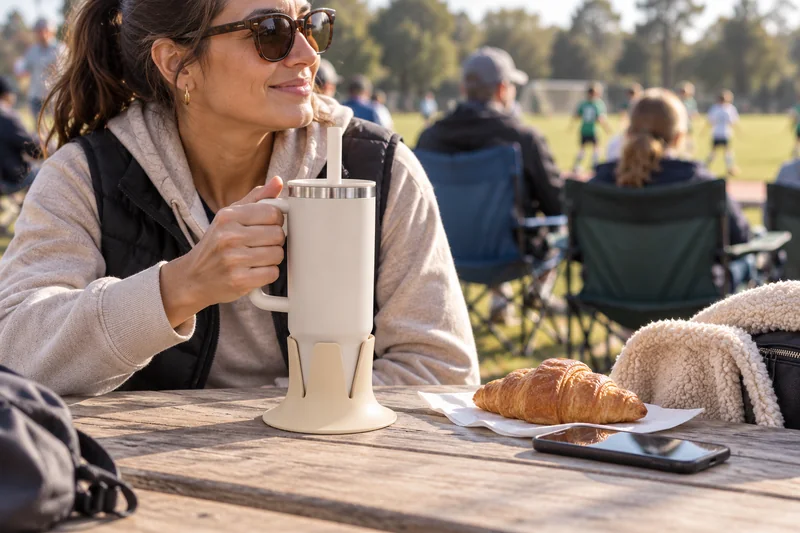
That's the physical requirement a wide, flexible base with fins meets: a container base of 2 to 3 inches settles in fully, and the fins flex to seat bases as wide as 3.15 inches — a snug fit for cups like the Stanley 30 oz FlowState Quencher, which run right at that edge. Set on the ground instead of the armrest, it never rides the part of the chair guaranteed to move, and it resists tipping when a cleat, a sibling, or the family dog brushes it, settling back down instead of going over.
None of that requires the field to get regraded or the chair's mesh loop to finally fit a bigger cup — just a base that already accounts for both. Steadi Labs molds it in small runs in Orange, California, and ships every order free to whichever sideline is next on the schedule.
Build your set — free shippingCheckout lives at steadilabs.com, home of the company behind it.